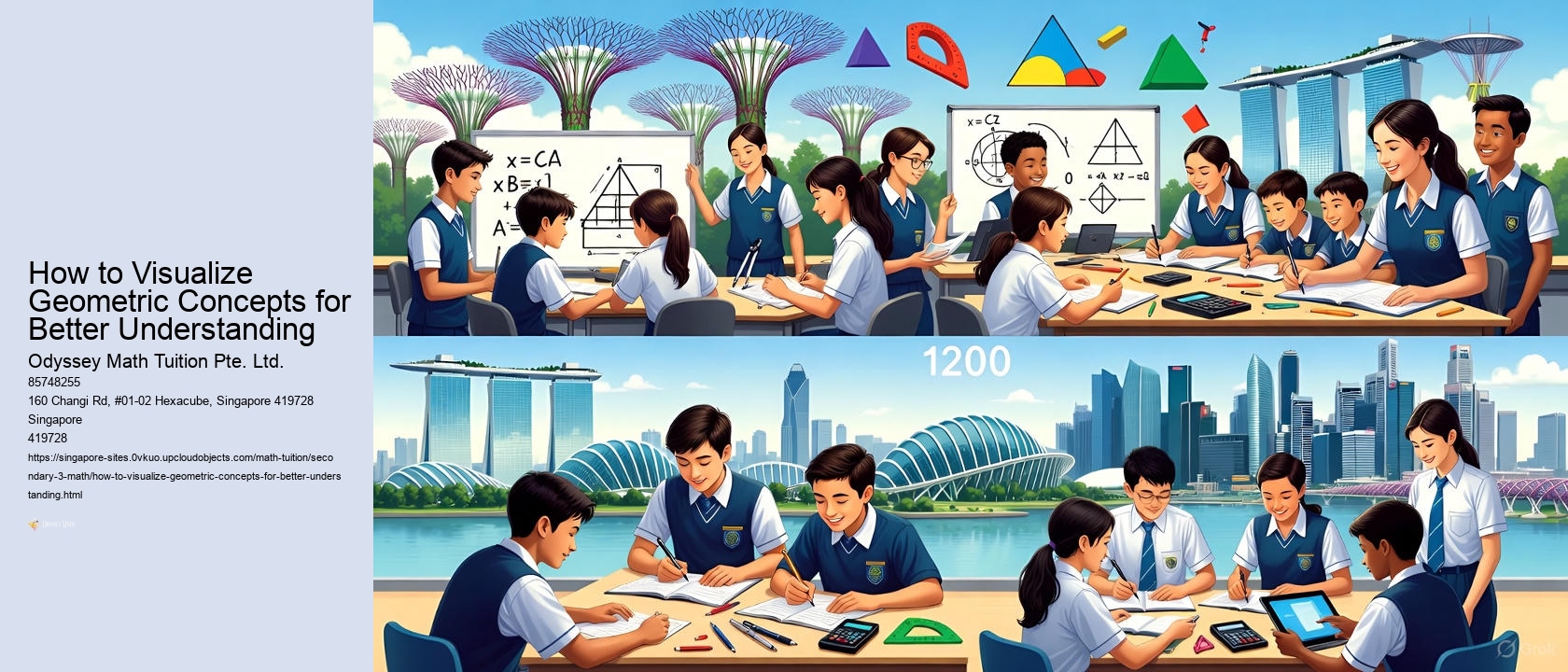
How to Visualize Geometric Concepts for Better Understanding
Introduction: Geometry - More Than Just Shapes
Hey parents and Secondary 3 students! Let's be real, right? In Singapore, acing your exams, especially in subjects like Math, is practically a national sport. And when it comes to Secondary 3 Math, geometry and trigonometry can feel like climbing Mount Everest…backwards. In today's competitive educational environment, many parents in Singapore are looking into effective strategies to enhance their children's grasp of mathematical concepts, from basic arithmetic to advanced problem-solving. Creating a strong foundation early on can significantly elevate confidence and academic success, aiding students conquer school exams and real-world applications with ease. For those considering options like secondary 3 math it's crucial to focus on programs that highlight personalized learning and experienced support. This strategy not only addresses individual weaknesses but also fosters a love for the subject, resulting to long-term success in STEM-related fields and beyond.. But don't chiong (rush) into rote memorization just yet! We're here to tell you that geometry is way more than just memorising formulas and theorems. It's about seeing the Math, feeling the Math, and understanding how it all fits together. This is how to excel in Singapore Secondary 3 Math.
Think about it: from the sleek architecture of Marina Bay Sands to the precise angles in your phone's design, geometry is everywhere. And with AI becoming increasingly prevalent, a solid grasp of mathematical concepts, especially geometry, is no longer just about getting good grades. It's about future-proofing your child's career! Because let's face it, the jobs of tomorrow will demand strong analytical and problem-solving skills, all rooted in a strong mathematical foundation.
Geometry and Trigonometry Essentials
So, how do we ditch the kiasu (fear of losing out) cramming and embrace a deeper understanding? It starts with the fundamentals. Geometry and trigonometry are the building blocks, lah!
Subtopics:
Angles and Lines: Understanding the relationships between angles (acute, obtuse, right, reflex) and lines (parallel, perpendicular, intersecting) is crucial. Can your child identify corresponding angles in a complex diagram? Can they visualize how angles change when a line is rotated? This is a key area to focus on for how to excel in Singapore Secondary 3 Math.
Triangles: Ah, the mighty triangle! In the city-state's demanding education framework, parents play a essential role in directing their youngsters through key evaluations that form academic paths, from the Primary School Leaving Examination (PSLE) which examines fundamental competencies in disciplines like numeracy and science, to the GCE O-Level tests emphasizing on secondary-level expertise in varied fields. As pupils advance, the GCE A-Level examinations necessitate deeper analytical capabilities and topic proficiency, often deciding university entries and career trajectories. To stay updated on all facets of these countrywide evaluations, parents should check out formal materials on Singapore test papers offered by the Singapore Examinations and Assessment Board (SEAB). This ensures entry to the newest syllabi, assessment calendars, sign-up details, and guidelines that correspond with Ministry of Education criteria. Consistently consulting SEAB can assist families get ready efficiently, lessen doubts, and bolster their children in achieving optimal outcomes during the demanding scene.. From Pythagoras' theorem to trigonometric ratios (sine, cosine, tangent), triangles are the foundation for so much in geometry. Make sure your child understands the different types of triangles (equilateral, isosceles, scalene, right-angled) and their properties.
Circles: Radii, diameters, chords, tangents… circles can seem like a whole new world. But understanding their properties is essential for solving many geometry problems.
In the challenging world of Singapore's education system, parents are increasingly intent on arming their children with the skills needed to succeed in intensive math curricula, including PSLE, O-Level, and A-Level studies. Spotting early signs of challenge in topics like algebra, geometry, or calculus can create a world of difference in fostering resilience and proficiency over advanced problem-solving. Exploring trustworthy math tuition Singapore options can provide customized assistance that aligns with the national syllabus, guaranteeing students acquire the edge they require for top exam scores. By prioritizing interactive sessions and steady practice, families can support their kids not only meet but exceed academic expectations, paving the way for future opportunities in demanding fields..
3D Shapes: Don't forget about solids! Cubes, cuboids, prisms, pyramids, cylinders, cones, and spheres – visualizing these shapes and calculating their surface area and volume is an important part of the Sec 3 syllabus.
Fun Fact: Did you know that the word "geometry" comes from the Greek words "geo" (earth) and "metron" (measurement)? The ancient Egyptians used geometry extensively to survey land after the annual flooding of the Nile River.
How to Visualize Geometric Concepts for Better Understanding
Okay, now for the shiok (amazing) part: visualization! Here's how to make those geometric concepts come alive:
Hands-on Activities: Forget just reading about it! Use building blocks, origami, or even everyday objects to demonstrate geometric principles. Can you build a cube from paper? Can you create different types of triangles using straws?
Interactive Software and Apps: There are tons of amazing online resources that allow you to manipulate geometric shapes and explore their properties. GeoGebra is a popular choice, and many educational apps are available on tablets and smartphones.
Real-World Examples: Point out geometric shapes in your surroundings. Look at buildings, furniture, even food! How many triangles can you find in a slice of pizza? How many circles are there in a bicycle wheel?
Diagramming and Sketching: Encourage your child to draw diagrams and sketches when solving geometry problems. This helps them to visualize the problem and identify the relevant relationships.
Break It Down: Complex shapes can be intimidating. Teach your child to break down complex shapes into simpler components. Can a pentagon be divided into triangles?
Interesting Fact: The golden ratio, approximately 1.618, appears in many natural phenomena, from the spiral arrangement of sunflower seeds to the proportions of the human body. It's also closely related to the Fibonacci sequence and has been used by artists and architects for centuries to create aesthetically pleasing designs.
History: The Elements, written by the Greek mathematician Euclid around 300 BC, is one of the most influential works in the history of mathematics. It provides a comprehensive and logical framework for geometry and has been used as a textbook for over 2000 years. Learning about the history of Math can be an interesting way to learn how to excel in Singapore Secondary 3 Math.
By focusing on visual understanding and making Math relevant to the real world, you can help your child not only ace their Secondary 3 exams but also develop a lifelong love of learning. And who knows, maybe they'll even design the next iconic building in Singapore! Majulah Singapura (Onward Singapore)!
How can Singaporean Secondary 3 students use real-world objects to visualize geometric concepts?
Encourage your child to find geometric shapes in everyday objects, like identifying cylinders in drink cans or parallel lines in buildings. This helps make abstract concepts more concrete.
What are some effective online tools for visualizing geometry for Secondary 3 students?
Explore interactive geometry software like GeoGebra or Desmos. These tools allow students to manipulate shapes, angles, and lines, leading to a deeper understanding.
How can parents help their Secondary 3 children connect geometric formulas to visual representations?
When learning formulas, draw diagrams and label them with the variables in the formula. This helps students understand what each part of the formula represents visually.
Why is it important for Singaporean Secondary 3 students to visualize geometric concepts?
Visualizing geometry helps students develop spatial reasoning skills, which are crucial for problem-solving and understanding more advanced mathematical topics.
What are some common challenges Secondary 3 students face when visualizing geometry, and how can they be overcome?
Some students struggle with spatial awareness. Using 3D models, building with construction toys, or practicing with isometric drawings can help improve this skill.
How can Singaporean Secondary 3 students use color-coding to enhance their understanding of geometric diagrams?
Use different colors to represent different lines, angles, or shapes in a diagram. This makes it easier to differentiate between elements and understand their relationships.
How does visualizing geometry help Singaporean Secondary 3 students in their school exams?
Visualizing geometric concepts enables students to solve problems more efficiently and accurately, as they can mentally manipulate shapes and understand spatial relationships, leading to better exam performance.